
Patient Guide: Checking Your Skin and Moles
A patient guide by dermato-oncologist Dr. Nazar V. Tsalin: why your skin growths should be checked, how the exam works and what to watch for on your own. You can read it here or download and print it.
Why does it matter?
Skin cancer is one of the most common cancers in the world, and here is the key thing about it: caught at an early stage, it can almost always be treated.
Caught at a late stage, it can threaten your health and even your life.
Most patients whose exam revealed a malignant growth had no idea it was there.
Not because they ignored the problem — but because in its early stages a malignant growth does not look alarming and caused them no trouble at all.
That is exactly what dermoscopic screening is for.
How do I book an exam?
Book an exam at the Trichology Institute. Appointments are with Dr. Nazar V. Tsalin.
Address: 17 Danylevskoho St, Kharkiv
Booking phone: 095 926 2585
More about the appointment: dermato-oncology consultation with digital dermoscopy.
How does the exam work?
The doctor examines your entire skin surface with a dermatoscope — a special optical instrument that shows structures in skin growths the naked eye cannot see.
It is a painless, surface-only procedure.
You cannot tell a benign growth from a malignant one on your own. The way a growth looks is not a reliable criterion.
That is the dermato-oncologist's job.
Who is at higher risk?
Regular exams are especially important if you have at least one of the following factors:
- Fair skin, light hair, light eyes
- A tendency to sunburn
- Many moles — more than 50, or large ones with an unusual shape
- Long hours working in the sun, or tanning bed use
- Skin cancer in the past
- Weakened immunity — after an organ transplant, with autoimmune diseases or on immunosuppressive therapy
If you have even one of these factors, a yearly exam is a must. For everyone else, it is strongly recommended.
How can I spot a problem myself?
The criteria below do not replace a doctor's exam, but they help you get help in time — and you can check not only yourself but your loved ones too.
Criterion 1 — ABCDE (melanoma)
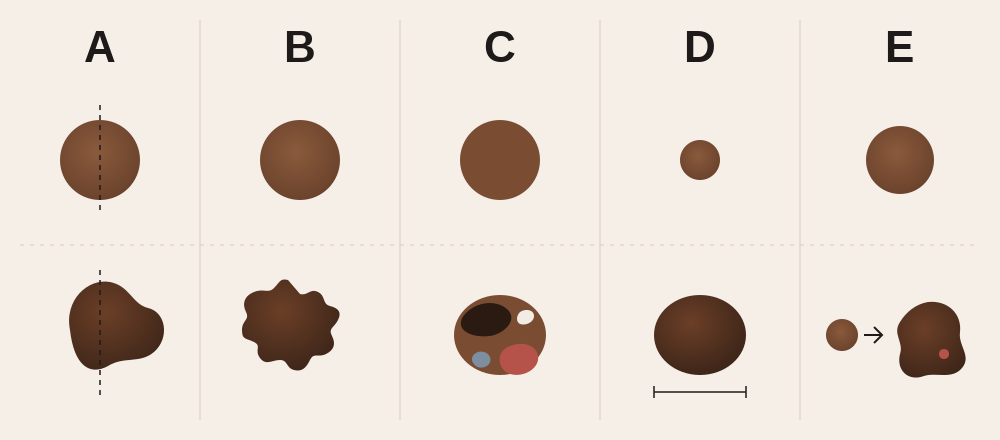
- A — Asymmetry. If you draw a line through the center of the mole, its two halves do not match in shape.
- B — Border. The edges are indistinct, blurred, uneven, “ragged” or notched.
- C — Color. Several shades in one growth: brown, black, red, white, blue.
- D — Diameter. Larger than 6 mm (the size of a pencil eraser). Smaller melanomas exist too, so this criterion is not the main one.
- E — Evolution. The growth has changed: it has grown, changed color or shape, started to bleed, itch or flake.
The letter E is the most important one. Any change you notice in a growth is a reason to see a doctor, whatever the other criteria say.
Criterion 2 — the “ugly duckling”

Look over all the moles on your body as a whole. In most people, the moles on the body look like one another — in shape, color and size. That is normal.
A growth that clearly stands out from the rest — one that looks different from all the others — needs to be seen by a doctor.
It may be darker or lighter than the others, a different shape, a different color — even bluish, reddish or almost white. That growth is the “ugly duckling.”
Important: in its early stages, melanoma often looks completely harmless — a small, barely noticeable spot. That is why ABCDE and the “ugly duckling” sign add to a doctor's exam rather than replace it.
Criterion 3 — warning signs of non-melanoma skin cancers
Basal cell and squamous cell skin cancers are far more common than melanoma: basal cell carcinoma (basalioma) and squamous cell skin cancer.
In the early stages, patients often describe them as:
- A small reddish or skin-colored spot that appeared recently
- A “pimple” or bump that grows slowly and will not go away — no matter how it is treated
- A patch of skin that bleeds now and then, crusts over, then “heals” — and then it all happens again
- A shiny, pearly or waxy bump
Any of these signs is a reason to see a dermato-oncologist, even if the growth does not hurt or bother you. More examples: what skin cancer looks like.
Sun protection — not optional, but essential
Ultraviolet radiation is a proven carcinogen and the main risk factor for skin cancer.
Practical tips:
- Use SPF 50+ every day — including on cloudy days and in winter
- Apply sunscreen 20–30 minutes before going outside, and reapply every 3–4 hours when you are active in the sun
- Stay out of direct sun from 10 a.m. to 4 p.m.
- Wear clothing that covers your skin, hats and sunglasses
- Give up tanning beds — artificial UV radiation is no less dangerous than the sun's
The bottom line
“No one is ready to hear the diagnosis ‘cancer.’ But it can sound like a sentence — or like a chance to get rid of it in time.
The difference between these two scenarios is often measured not in years but in weeks — the time between ‘I noticed it and came in’ and ‘I noticed it, but waited.’
Come in yourself. Bring the people you love.
Early diagnosis is not paranoia. It is taking responsibility for yourself.”
— Dermato-oncologist and surgical oncologist Dr. Nazar V. Tsalin, Kharkiv
Diagnosis and treatment at the Institute
Get a consultation
About the author
Nazar V. Tsalin, MD, dermato-oncologist and surgical oncologist.
This guide is for information only and does not replace an in-person consultation with a doctor.